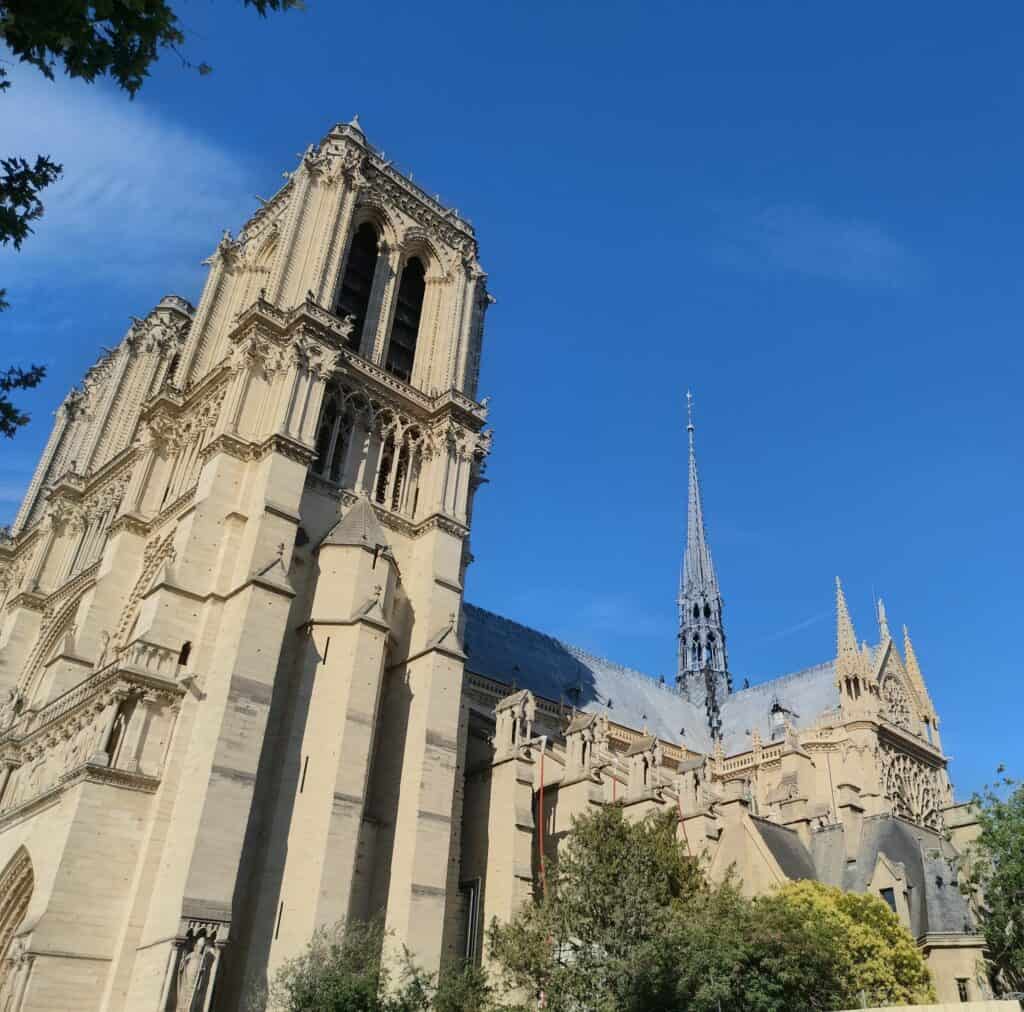
A Spectacular Ascent into the Sky
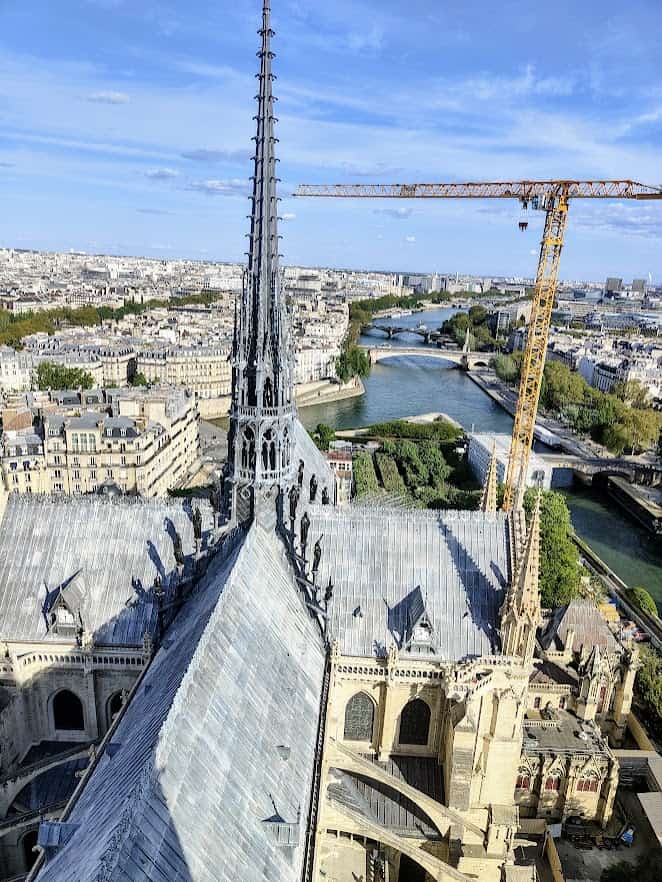
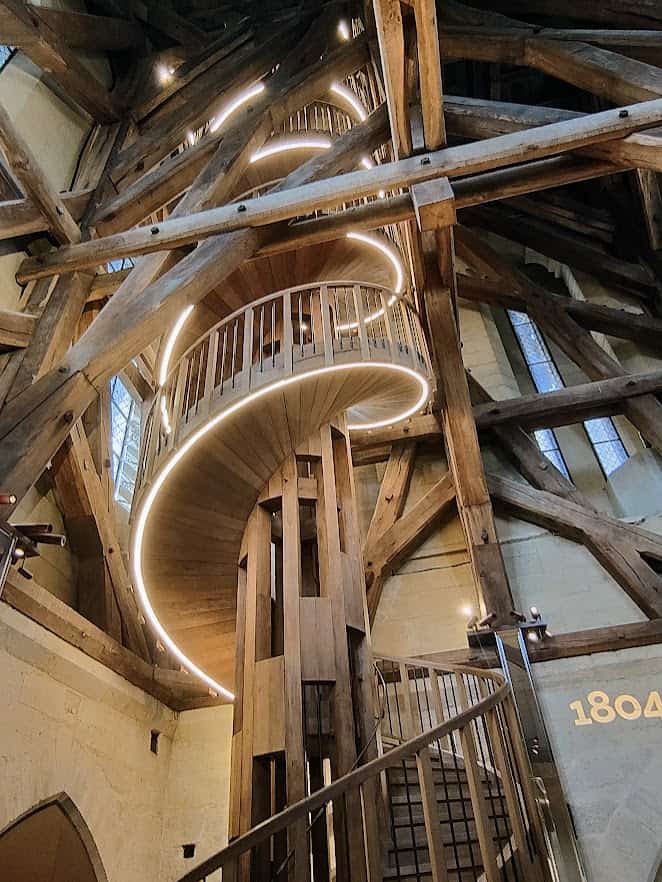
The towers of Notre-Dame: indeed, a true ascent to the sky. An exceptional climb that day under the watchful eye of the architect who restored them, Philippe Villeneuve. Are you ready to climb 424 steps to reach the Paris skyline and the roofs of Notre-Dame at a height of 69 meters? Better yet, why not take the new visitor route via the double-helix staircase designed and drawn by Philippe Villeneuve? A pure masterpiece in solid oak!
The South Tower: Spared by the 2019 Fire
Since the dramatic fire of April 15, 2019, the effect of these two miraculous towers remains spectacular. The interior is even more so. Everything—absolutely everything—has been entirely reorganized, redesigned, and secured. The job was colossal. Today, rediscovering them from the inside comes as a profound shock! As is well known, was spared by the fire. For a long time, it left the spotlight to its northern twin (called the “large tower”). On the night of the fire, its belfry—a timber frame built to support the weight of the bells and absorb their vibrations so they wouldn’t transfer to the masonry—was the scene of the firefighters’ battle and final victory. The tower was saved in extremis, but many of its beams were charred by the fire. The eight bells it housed had to be removed by campanologists to allow the belfry to be restored. In September 2024, they were reinstalled after being blessed on the forecourt by Mgr Ribadeau Dumas, rector-archpriest of the cathedral.
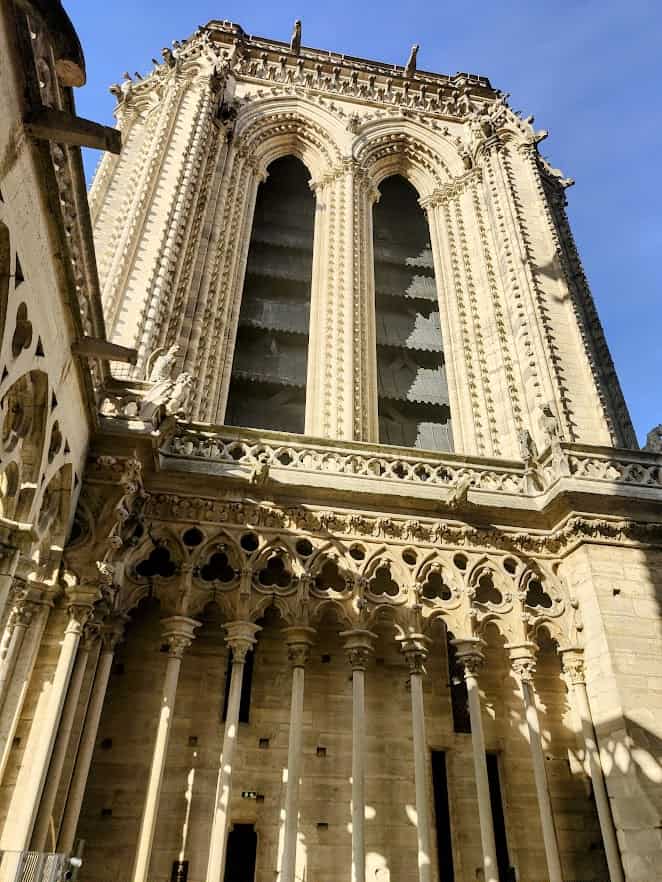
Starting from the Lower Room of the South Tower
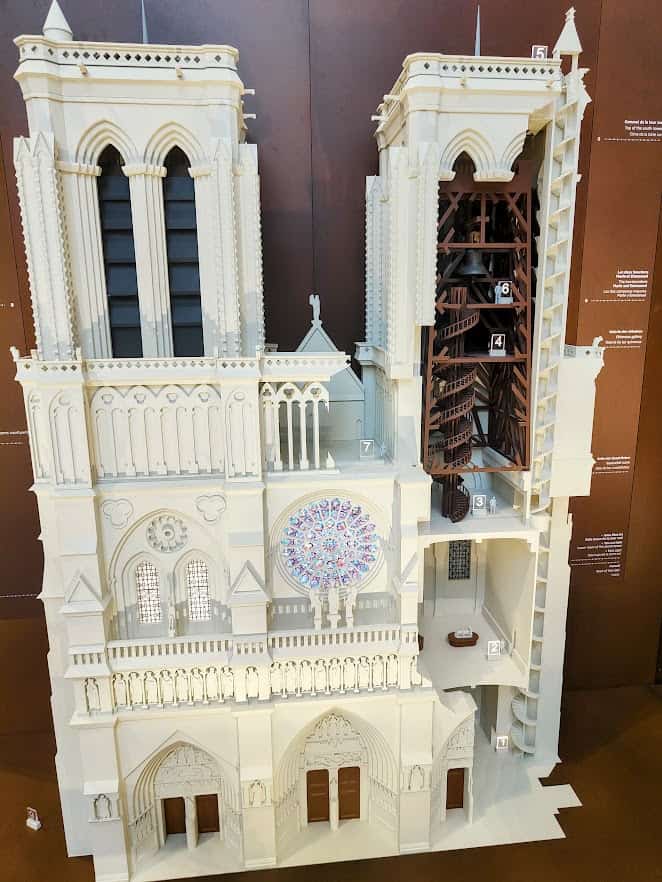
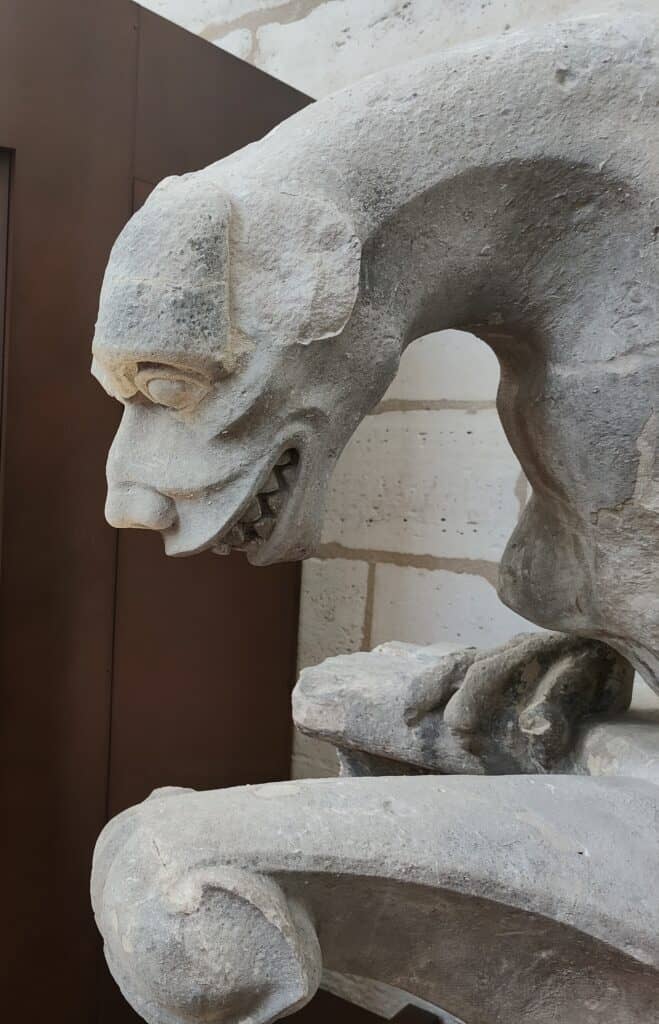
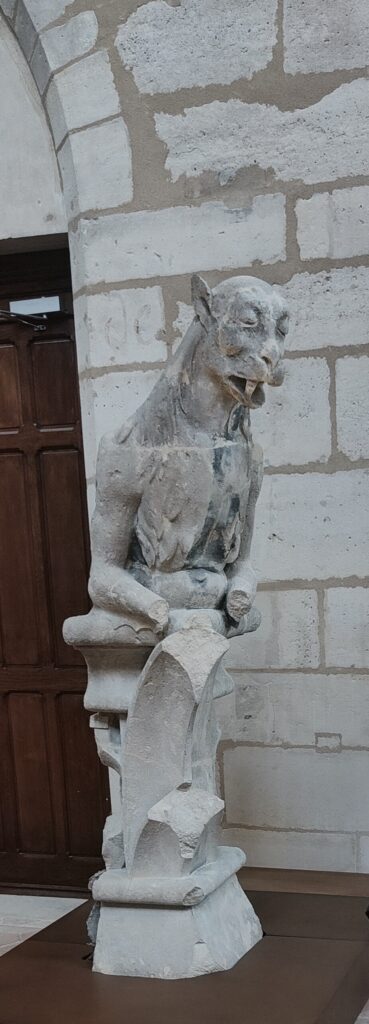
What a Welcome! Two Chimeras Rescued from the Fire
It is a 13th-century room with stone vaults, long known as the “music room.” It is furnished with two models of the cathedral: one three-dimensional and the other a cutaway view to help visualize the ascent. This room also displays two astonishing original chimeras that survived the fire. They originate from Viollet-le-Duc’s medieval imagination, inspired by Victor Hugo’s novel Notre-Dame de Paris*: The Woman with a Dog’s Head and The Creature Showing Its Fangs—original limestone sculptures by Victor Pyanet (second half of the 19th century).
Above the lower room lies the Room of the Quadrilobes (named after the shape of its windows). It forms the base of the (fully restored) belfry, today occupied by Philippe Villeneuve’s grand double-helix staircase, standing 21 meters tall.
Notre-Dame features 54 chimeras—a fantastic medieval bestiary adorning the corners of the balustrade surrounding the towers and crowning the upper gallery that connects them (the Courtyard of the Cisterns). Here, goats, oxen, felines, and birds mingle with dragons, horned demons, and hybrids with human bodies and lion heads.
At the Foot of the Staircase, the Architect’s Genius is Revealed
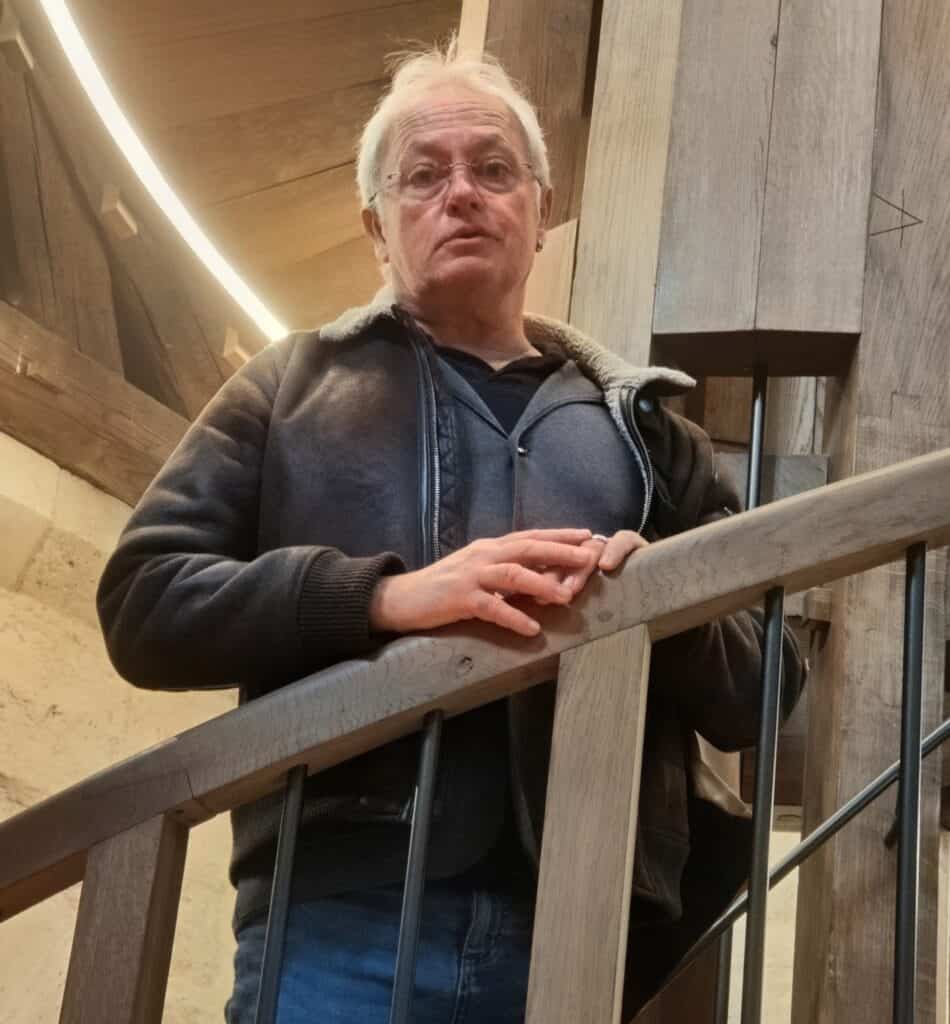
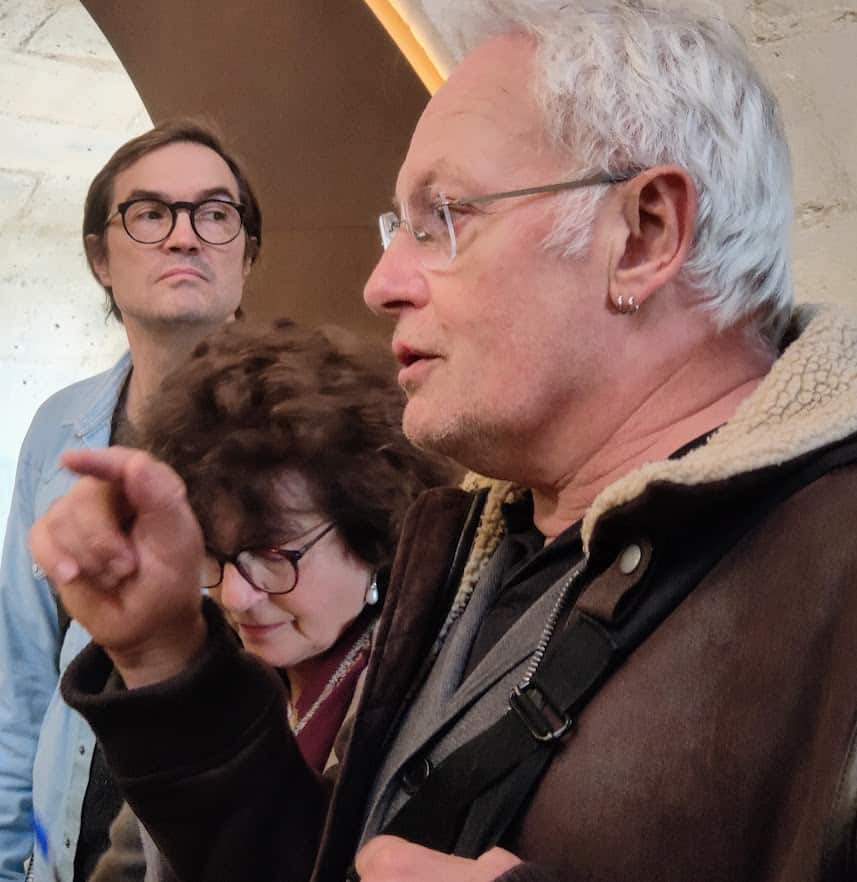
On the first steps of the famous double-helix, self-supporting staircase*, its creator, Philippe Villeneuve, awaits us. He is the chief architect and restorer of the cathedral, as well as the designer of this now-iconic staircase.
A staircase that required nearly 1,400 hours of studies (execution plans, structural calculation notes) and, in the autumn of 2024, approximately 9,200 hours of workshop fabrication by a team of around fifteen carpenters, three joiners, and three apprentices.
The Double-Helix Staircase Leading to the Emmanuel Drone Bell
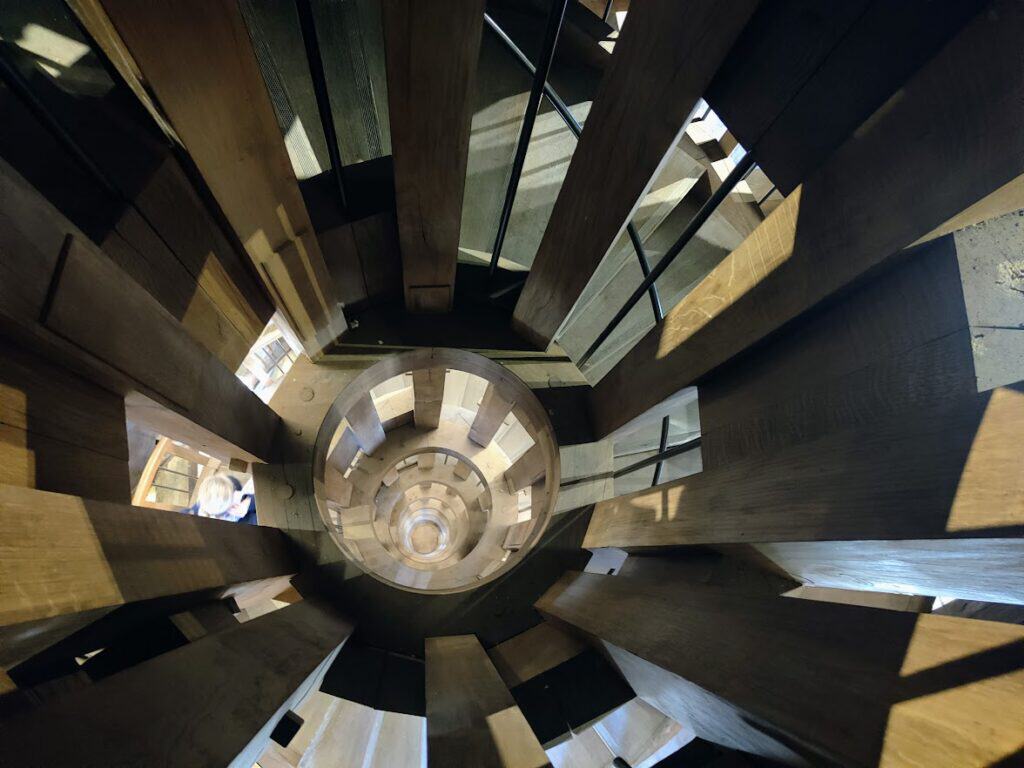
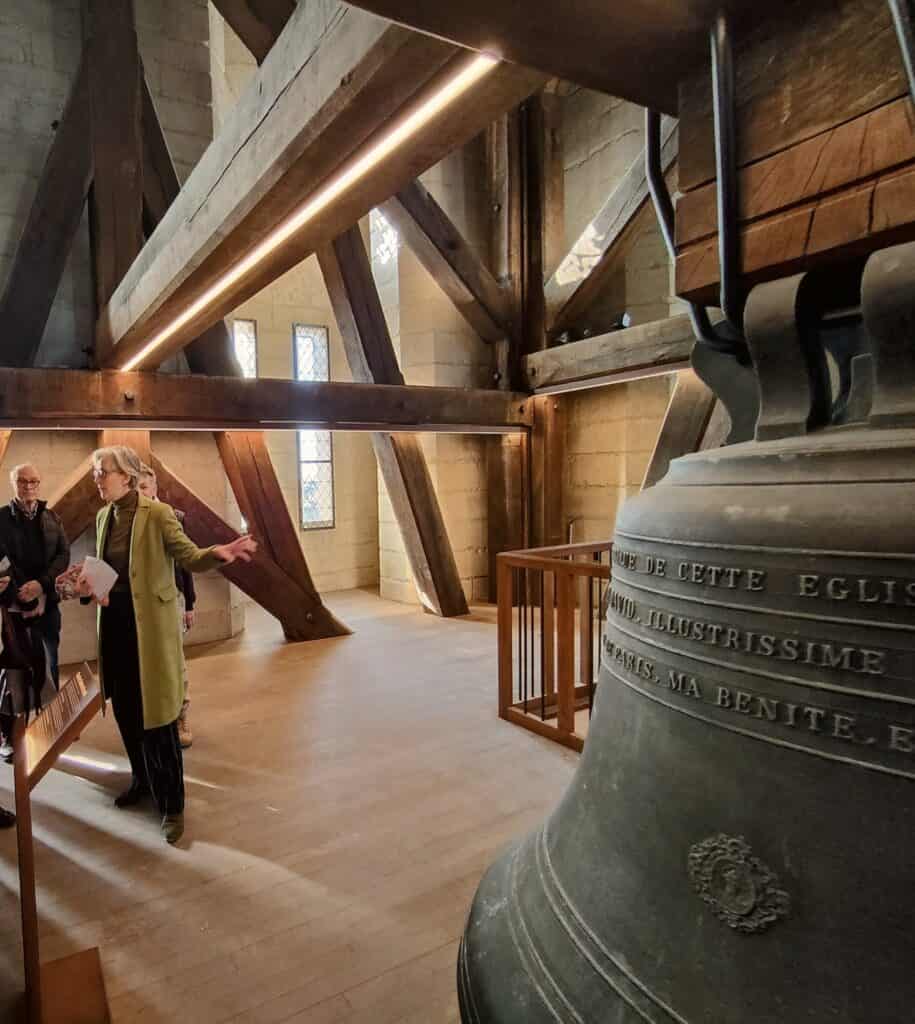
Look up—its dizzying elevation seems to lose itself in the heights and timber framework of the belfry. It provides an ascent (previously inaccessible to view) to one of the cathedral’s supreme masterpieces: the location of the great bell (bourdon) named Emmanuel. Weighing 13 tons, it is the most famous bell in Notre-Dame, classified as a historical monument on July 24, 1944, in the midst of the Battle of Normandy. It is also the sole survivor of the French Revolution. It rings alongside the Marie drone bell (6.2 tons) only during major historic and religious events
For Whom Does the Great Drone Bell of Notre-Dame Toll in F-Sharp?
Far from being plunged into a silence imposed by the setting, the visit is also an immersive sound experience within a scenographic atmosphere designed to harmonize with that of the cathedral (featuring tones recalling traditional materials). Listen closely! At the foot of the stairs, short acoustic soundscapes play. They sound in F-sharp, reproducing the tone of Notre-Dame’s drone bell, cast in 1683 and christened Emmanuel by its godfather, King Louis XIV. It has tolled for all the major events in French history. So when it rang out in August 1944 during the liberation of Paris, what an emotional moment it was for Parisians!
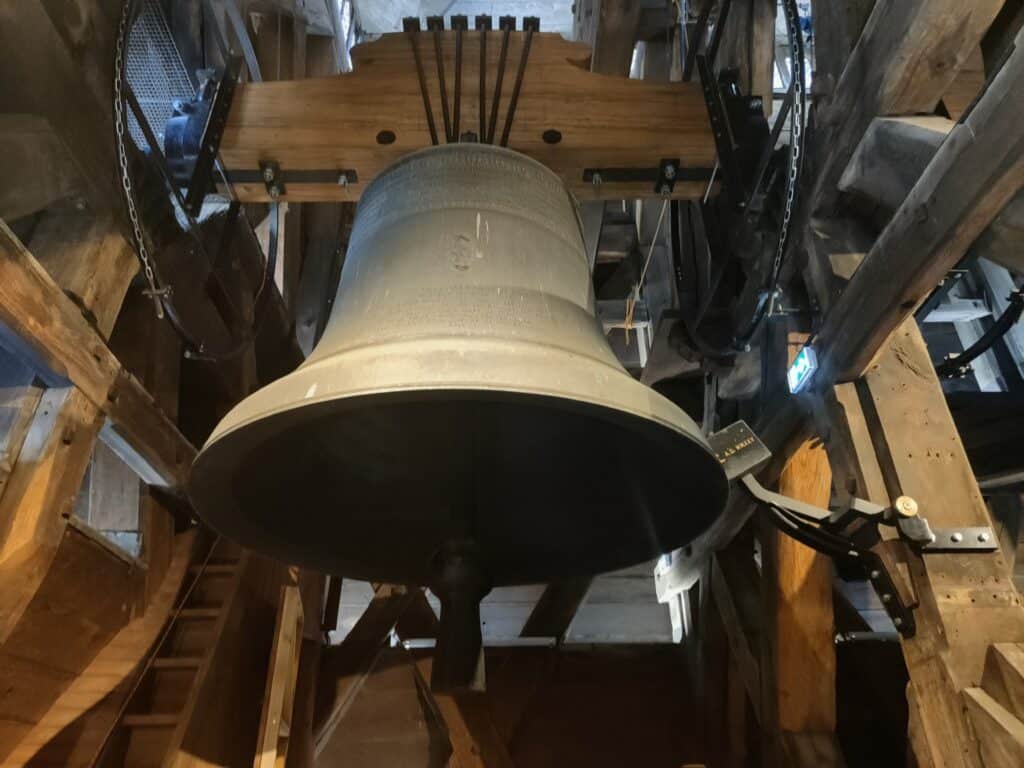
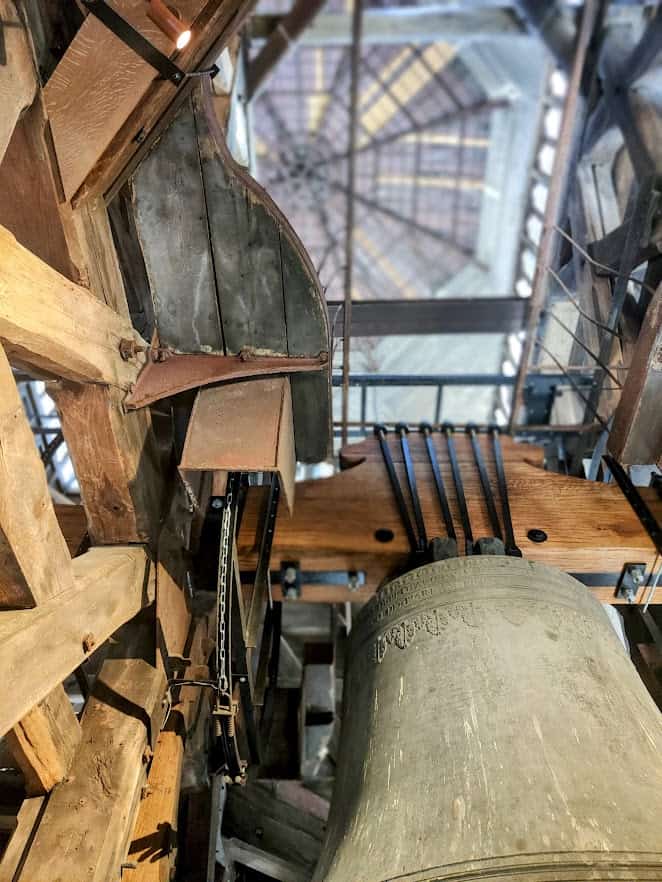
The Eight Bells of the North Belfry
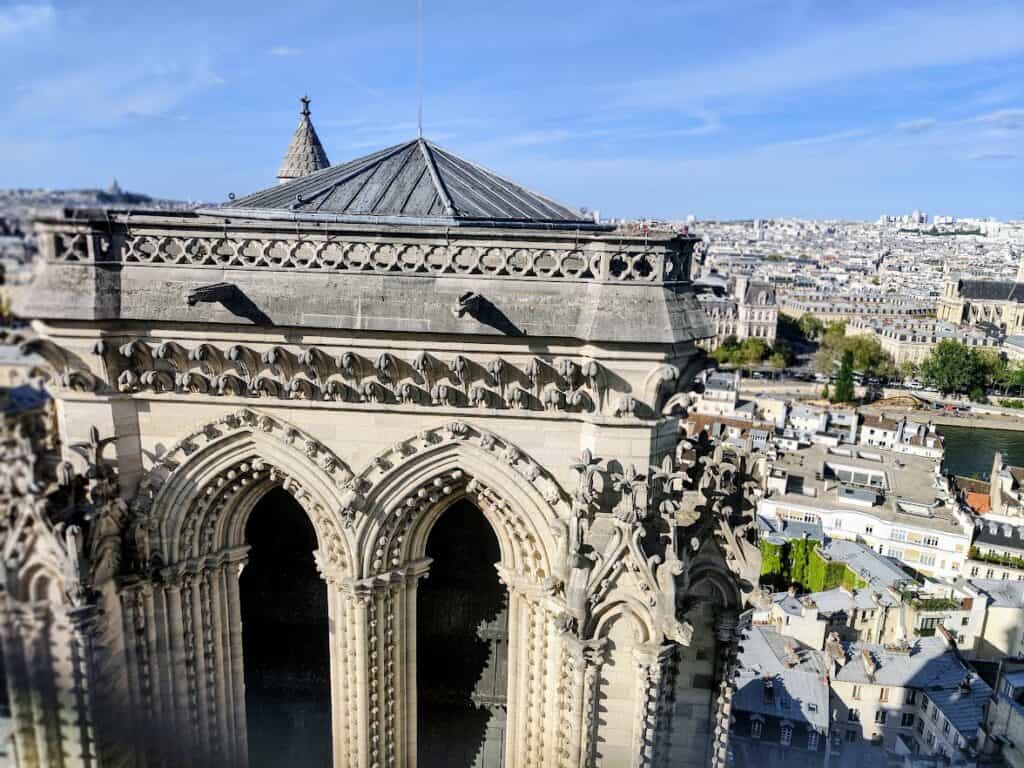
A New Access Point to the Courtyard of the Cisterns
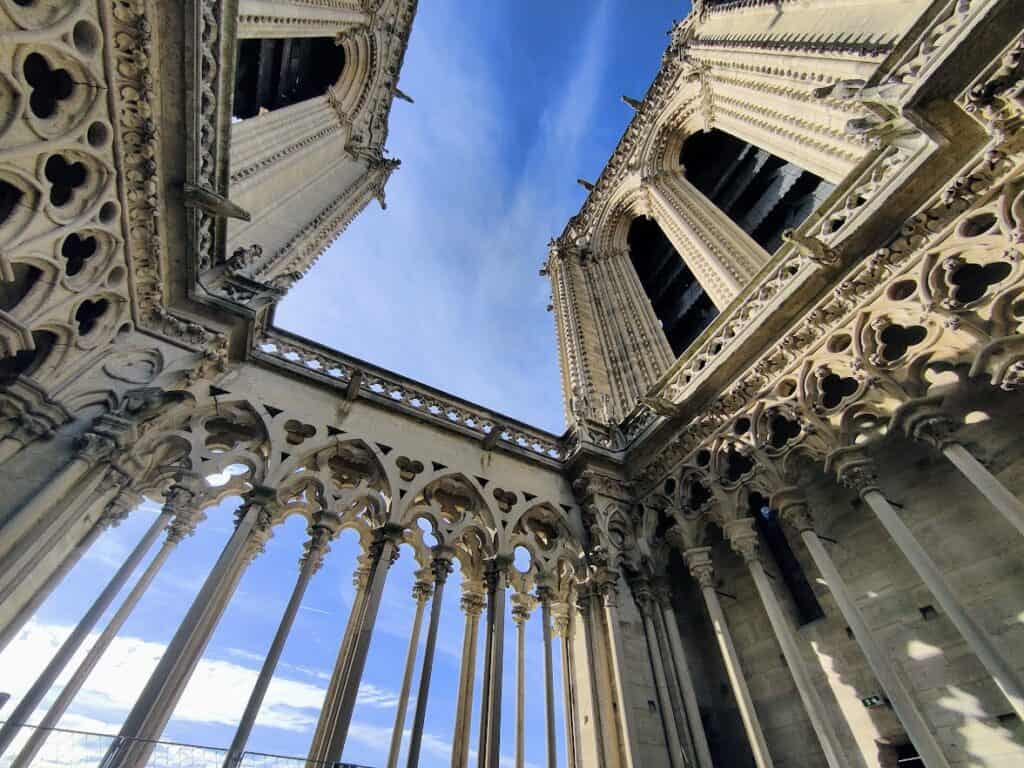
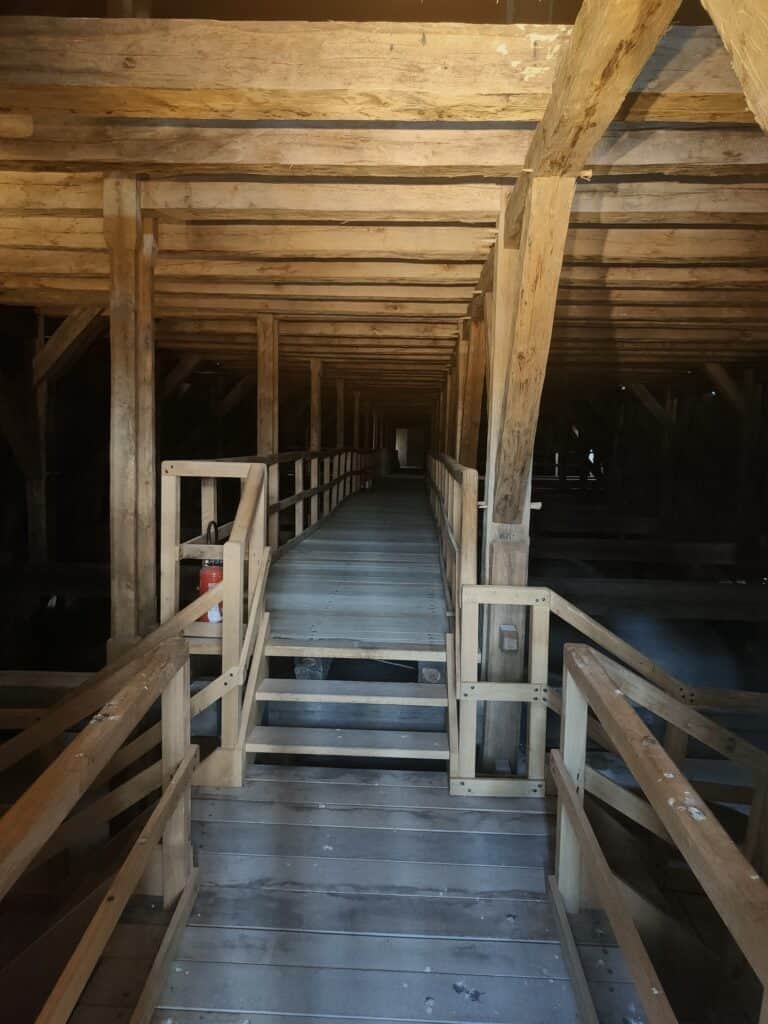
Thanks to this double-helix staircase*, visitors can now climb inside the belfry (previously hidden from view) up to the Courtyard of the Cisterns, which connects the two towers. It is an apt name in memory of the large rainwater catchments located there in the 18th century above the first bay of the nave between the towers. From here, a walkway provides close-up access to the two drone bells. From this courtyard, another deeply moving moment awaits: one can catch a glimpse (without entering) of the framing of the main roof structure—the famous “Forest” above the nave.
Two other single-helix staircases—one in the South Tower and one in the North Tower—provide improved movement across the towers while securing emergency acces.
To the Summit of the South Tower, in the Paris Sky
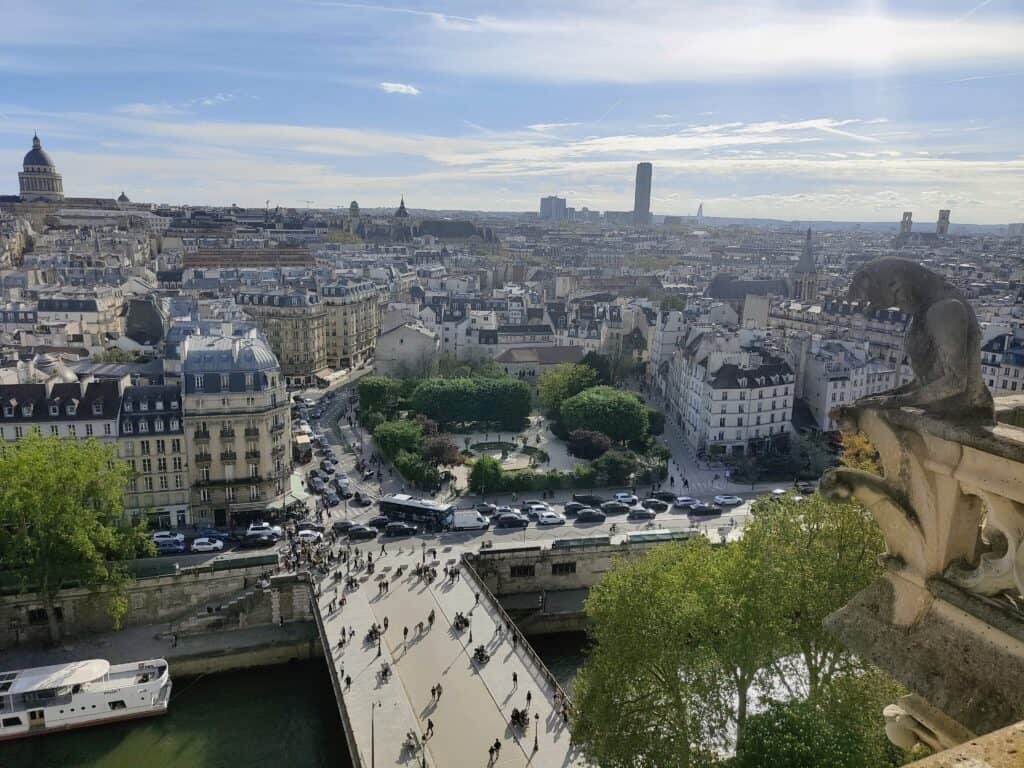
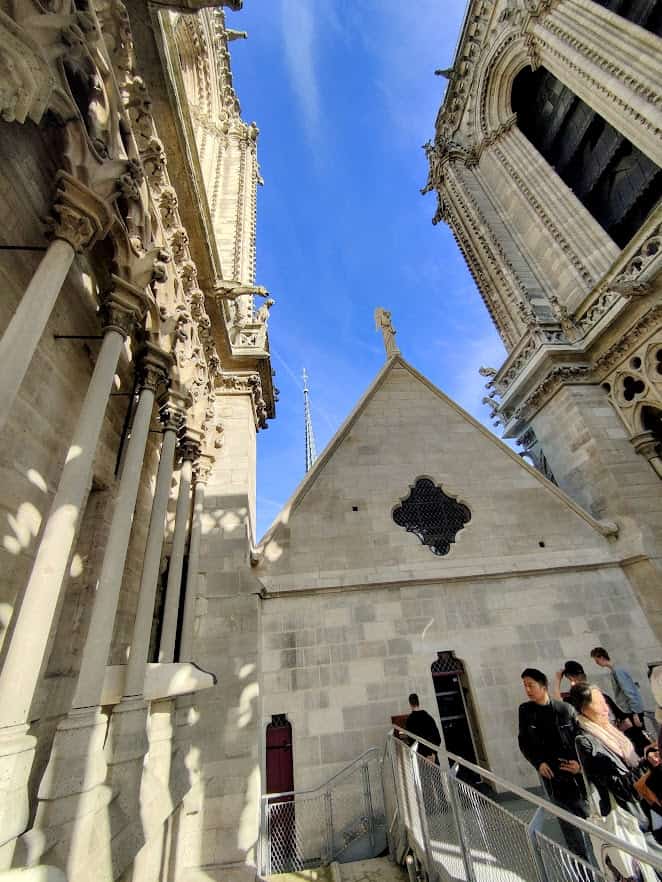
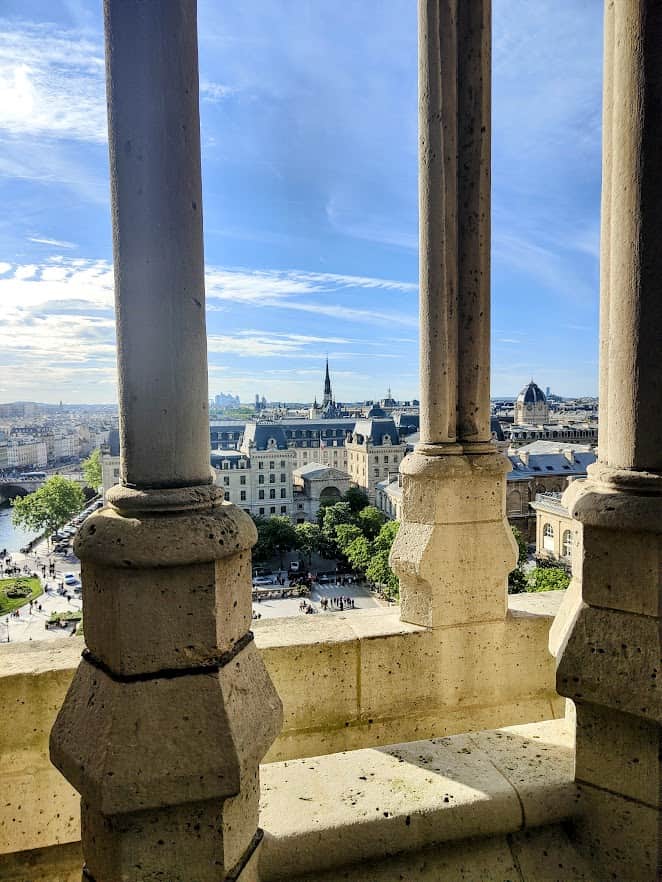
It is possible to shorten the climb via the double-helix staircase, or better yet, attempt the full ascent by climbing the 424 steps of the spiral staircase. It grants access to a height of 69 meters at the summit (or nearly so) of one of the world’s most iconic monuments! Up at the top, the spectacle is breathtaking: a 360° panoramic view over Paris
So Close to the Spire
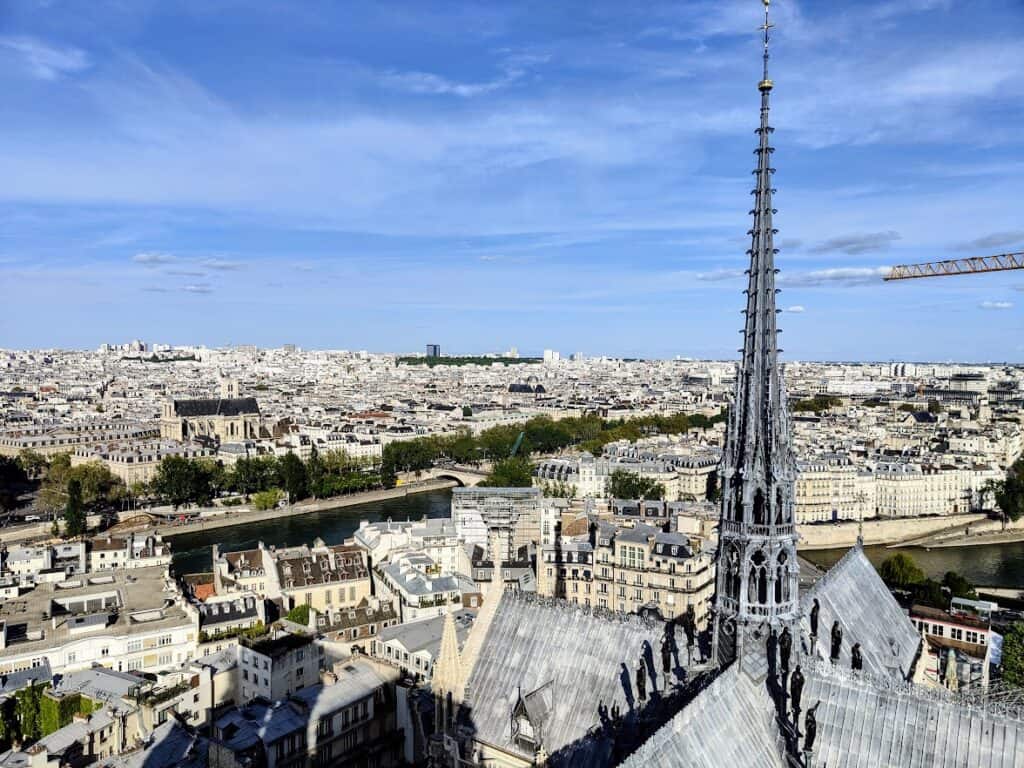
Just a few meters away, soaring above the transept crossing (as if you could simply reach out and touch it!), stands the new spire. It replaces the one carried away by the flames in 2019: standing 48 meters high, remarkably slender, majestic, and sparkling under the setting sun. Can one even imagine that it consists of 500 tons of oak and is clad in 250 tons of lead, culminating at 96 meters above the ground?
What truly catches the eye, however, are the statues standing at the four cardinal points along the ridge lines at the base of the spire. Grouped four by four like a majestic cohort, here are the twelve apostles (along with the symbols of the four evangelists: the lion, the bull, the angel, and the eagle) back in the exact positions assigned to them by Viollet-le-Duc in the 19th centur
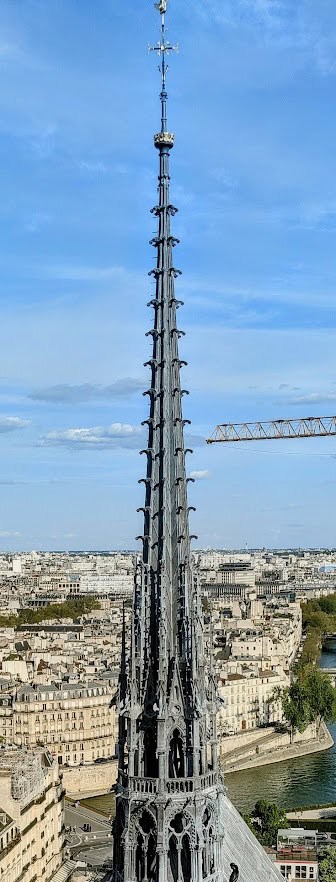
The Miraculous Survivors of the Fir
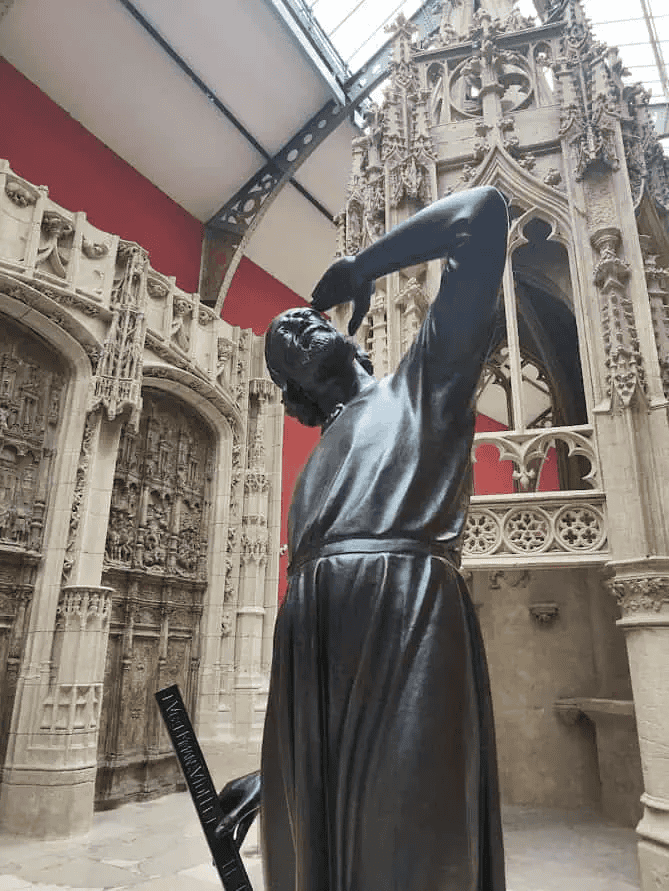
These statues are the miraculous survivors of the 2019 disaster, having been removed for restoration just days before the fire. Among them, can you recognize Saint Thomas? He has reclaimed his pedestal at the base of Notre-Dame’s spire. His bronze statue, like the others, stands 3 meters tall and weighs 100 kg. This apostle, the patron saint of architects, bears the face of Viollet-le-Duc—a fitting tribute, as he was the chief craftsman of the cathedral’s restoration between 1844 and 1864.
The Face-to-Face of the Two Architects
It is only fitting, then, that the likeness of Philippe Villeneuve—who served from 2019 to 2025 as the chief architect responsible for Notre-Dame’s restoration—should also be present. And indeed it is. With a very keen eye, you can discover, in a far more modest fashion, a representation of his face at the tip of one of the lead crochets near the summit of the spire, just beneath the golden rooster he designed. It directly faces the statue of Saint Thomas, portrayed with the features of Viollet-le-Duc: a true face-to-face between two master architects!
Saint Thomas, the only apostle turned toward the spire of Notre-Dame
Philippe Villeneuve: The Man with the Rose Window and Spire Tattoos
Philippe Villeneuve, who was supervising the restoration of Viollet-le-Duc’s spire at the time of the fire, was reconfirmed in his position by the Minister of Culture to lead the securing and subsequent reconstruction of the monument. His profound love for the edifice had already inspired him to get a tattoo of the great rose window over his heart upon taking office in 2013 as chief architect of Notre-Dame de Paris, followed by a tattoo of the spire at the moment of its reconstruction.
At the Top of the Spire, the Rooster Announcing the Sunrise
Intact After a 96-Meter Fall
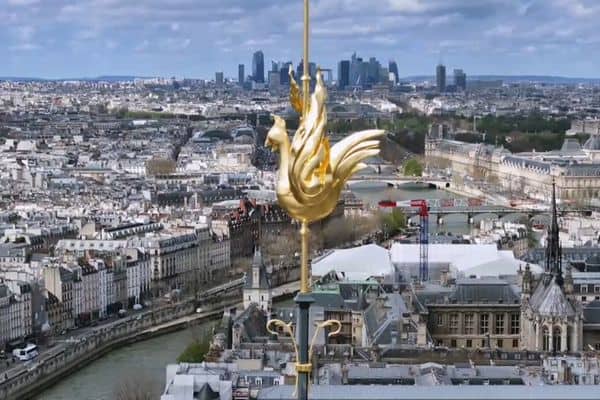
At the very peak stands the world-famous rooster. Today it gleams brilliantly—a work by Philippe Villeneuve (a copper sculpture covered in gold leaf, measuring 90 cm and weighing 25 kg). It houses three sacred relics: a piece of the Crown of Thorns, a relic of Saint Denis, and one of Saint Genevieve. It symbolizes the watchman announcing the dawn and the day of Resurrection. Inside the sculpture, a sealed tube contains a document bearing the names of all those who participated in the reconstruction—nearly 2,000 names in total.
The story of Viollet-le-Duc’s original rooster is nothing short of miraculous. On April 15, 2019, during the fire, it fell 96 meters. It was recovered almost intact—dented, but saved. The question arose whether to restore it. Ultimately, it was decided to create a new one while preserving the original as a historical witness, to be displayed in the future Notre-Dame Museum. And so, Philippe Villeneuve and Philippe Jost (president of the public agency Rebâtir Notre-Dame) handed the new rooster over to the Archbishop of Paris to be blessed and finally hoisted to the apex of the spire, so close to the heavens.
“This rooster has wings of fire; it serves as a reminder that a cathedral can rise from its ashes, like a phoenix.”
Philippe Villeneuve, Master Builder of Notre-Dame’s Restoration