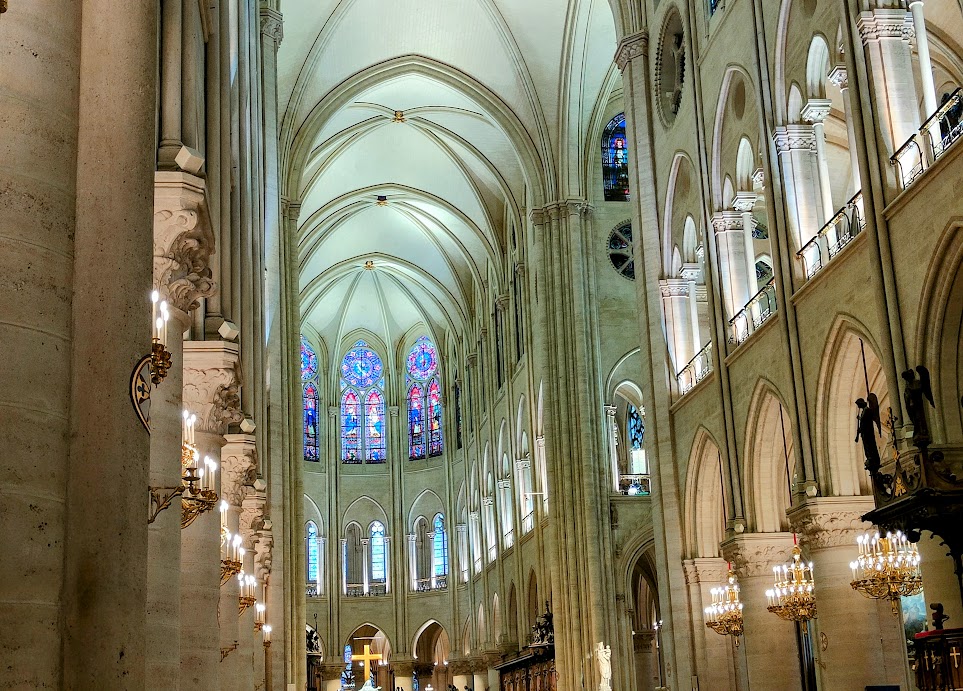
It’s hard not to be dazzled!
“Noble work shines, but only if it shines nobly. May it enlighten minds and guide them, by true lights to the true light of which Christ is the true door”
What a resurrection!
These verses by Suger, engraved on the great portals of the cathedral-basilica of Saint-Denis, could echo here after the magnificent rebirth of Notre-Dame de Paris. It’s incredible that a cathedral has regained the lustre of its youth! The miracle is that it has been able to unite in a single gesture ‘the cry of builders past and present’. ‘We wanted to unify the width and depth of the interior space, so that Notre-Dame could shine like never before,’ says Philippe Jost*.
*Philippe Jost is a senior civil servant who succeeded General Georgelin, who died in an accident, in September 2023. He is head of the public establishment responsible for the conservation and restoration of Notre-Dame.
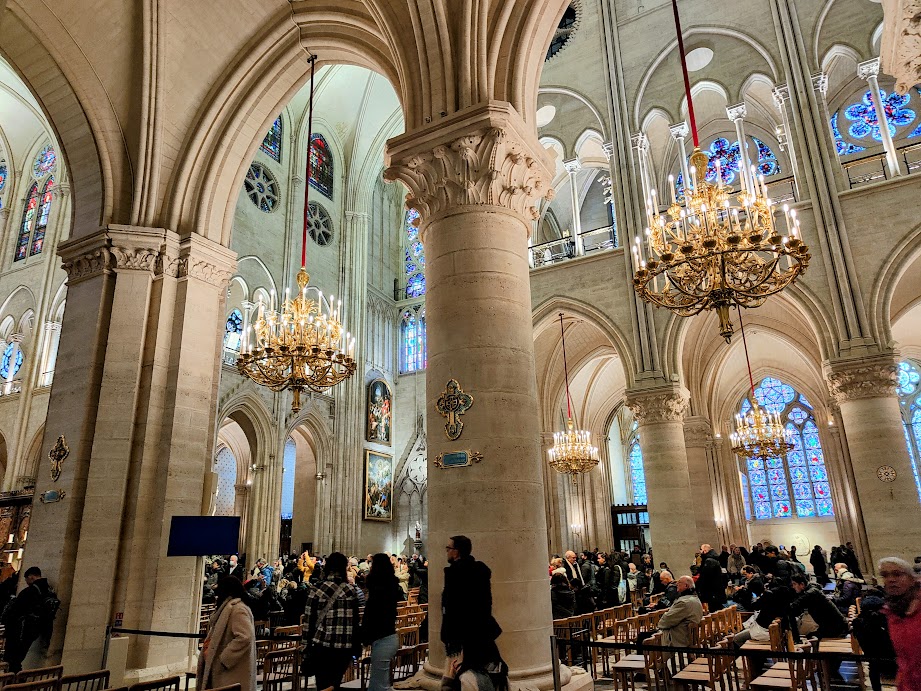
Crowds from all over the world
Five years on! A tragic fire irreparably damaged the cathedral’s roof. It destroyed the 12th-century roof structure. It swept away Viollet-le-Duc’s spire. It jeopardised the very structure of the building. But today, what a resurrection! The cathedral has reopened its doors. Since then, it has been a long procession, with crowds from all over the world admiring the fact that Notre-Dame has once again become their Notre-Dame.
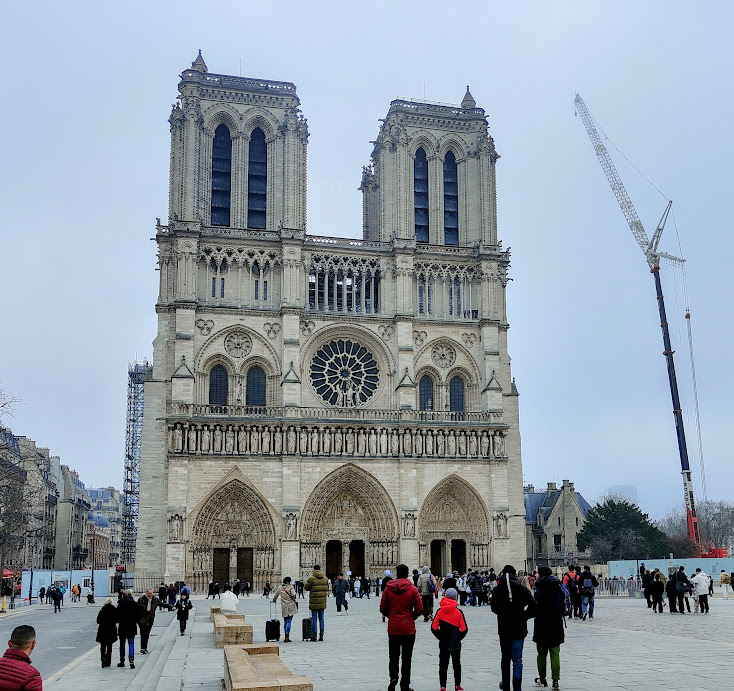
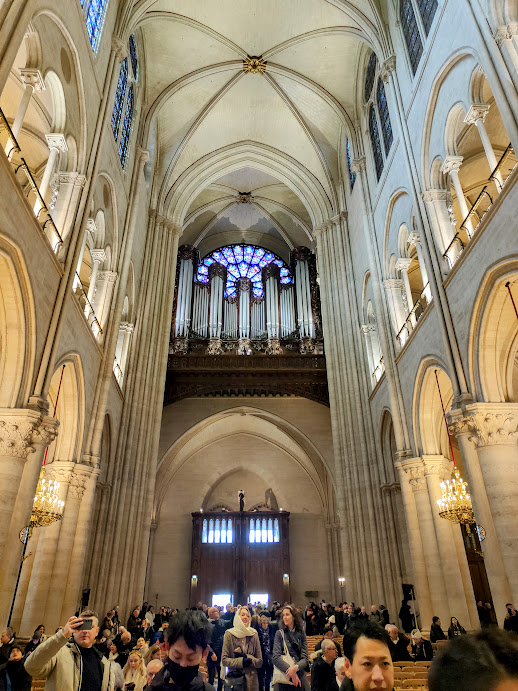
This mythical cathedral, so light, so harmonious and thought to be indestructible
Here it is, this mythical cathedral, so light, so harmonious and thought to be indestructible. It’s still there, docked, an immense vessel that has thrown its (rebuilt) spire over 90 metres into the air. Is there any monument in the world more admired and astonishing (even more so today) to the most jaded of visitors? Its roof, the framework of which has remained unchanged since the beginning (it has been identically restored), its chevet flanked by one of the most aerial crowns of buttresses 15 metres high, its nave, its galleries, its roses, its twelve portals – nothing disappoints. Everything here is a masterpiece once again. Everything has been cleaned of the dirt accumulated over the decades.
Everywhere, blonde stone shines again
Everywhere the blonde stone shines; revitalised stones where the dazzling colours of the stained-glass windows (partly restored) are projected in dashes, blending with the painted decorations of the twenty-nine chapels. What’s more, they are enhanced by new, adjustable lighting. The central axis features new minimalist liturgical furniture in solid brown bronze. And, incredibly, there are 1,500 new light oak chairs to welcome the faithful and some of the 14 to 15 million visitors expected each year.

Everything here is a masterpiece
Is there a single corner of Notre-Dame, a single parcel of stone, that has not been painted, described, illuminated, captioned, haunted by history under the disturbing gaze of a few gargoyles and monstrous chimeras, so dear to Victor Hugo? But a page was turned in 2019. Today, a new area opens up towards the next decades and even centuries.
A cathedral for humanity
On 15 April 2019, the roof and spire of Notre-Dame de Paris were destroyed by a gigantic fire. Frozen into a single block by the heat, the scaffolding surrounding the spire*, which was being renovated at the time, was completely removed to make way for the new spire. And the decision to rebuild a wooden framework based on the original was quickly made official. If this monument is ever completed,’ noted Robert de Thorigny in 1177, ’no other will be able to compare with it. In December 2024, Notre-Dame de Paris was inaugurated before the eyes of the world. The fire was just one more tragic date in the long history of the cathedral, an absolute masterpiece and a World Heritage Site.
*Fortunately, the statues on the spire, including the twelve apostles and four evangelists, which adorned the roof of Notre-Dame, narrowly escaped the fire as they had been removed a few days earlier to be restored.

€846 million donated in two days
On 15 April 2019, an accidental fire destroyed the cathedral’s roof structure (known as ‘the forest’). The spire, the work of Eugène-Emmanuel Viollet-le-Duc, collapsed onto the vaults of the transept crossing. Unimaginable! Notre-Dame was burning. The world was stunned. The tragedy triggered an unprecedented outpouring of generosity. Two days after the fire, on 17 April, pledges reached the staggering sum of almost €846 million. 350,000 patrons from 150 countries contributed to the rebirth of what is arguably the most admired cathedral in the world. Of course, there were the very large donors, the Arnault and Bettencourt-Meyers families, who contributed €200 million. The Pinault family and the Total Energies group (100 million euros each). Small donors numbered around 300,000, with an average donation of 236 euros. Among them were believers and atheists, Catholics, Protestants, Jews and Muslims.
Donations from 65,000 Americans
65,000 Americans, who are truly devoted to Notre-Dame, donated a total of 66 million euros to the reconstruction of Notre-Dame. But not all the funds were used. A further 18% is already being used to renovate the exterior of the building.
2000 men and women worked to restore Notre-Dame
The last firefighters left behind a blackened, gutted and lead-contaminated building. They are considered the true heroes of Notre-Dame. The immense army of restorers now faced a titanic task. A project that would last five years. More than 2,000 men and women worked on its restoration (architects of historic monuments, Compagnon du Devoir, carpenters, cabinetmakers, rope access technicians, stonemasons, scaffolders, crane operators, roofers, restorers, archaeologists….). 250 companies were involved in making Notre-Dame safe and restoring it. More than 2,000 oak trees were used to rebuild the spire and all the roof structures. 1,000 m³ of stone were needed to rebuild the vaults and walls that had been destroyed or damaged. 42,000 m² of stone were cleaned (vaults, columns). 4,000 m² of lead was used to rebuild the roof. 2,000 statues and decorations* were restored or rebuilt. The scaffolding installed to rebuild the spire was 100 m high.
*All the gilding was repainted, 22 paintings were completely restored, and the statues were scraped and cleaned.
A cathedral transformed
After five years of work, the cathedral will reopen its doors to the public on 8 December 2024 in a transformed building. Who wouldn’t be touched by the clarity, the light that fills the whole space? It’s dazzling. Not since the 13th century has anything like this been seen, such as the day King Louis IX entered the church barefoot to place Christ’s crown of thorns, a gift from the Emperor of Constantinople, on the altar. Can you imagine the extraordinary pomp of the ceremonies that took place there in the 13th century, amplified by the polyphonic music that had just been created?
The big day has arrived
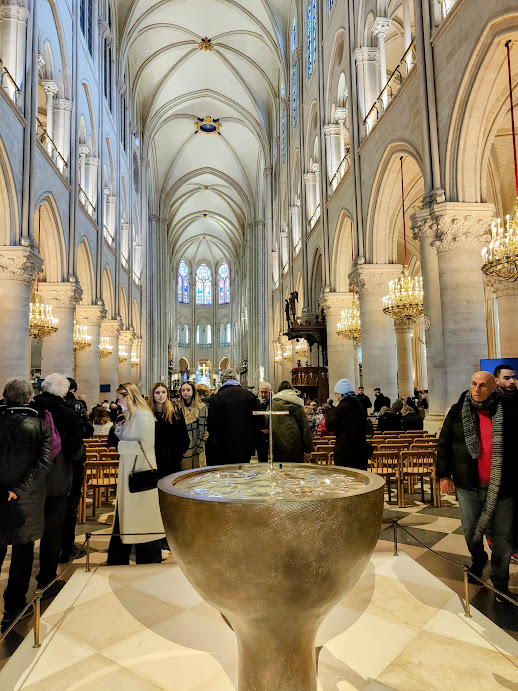
You can imagine the emotion felt by Archbishop Ulrich of Paris when the sound of the Emmanuel bumblebee, the cathedral’s largest bell, resounded in the Paris skies. He will then stand before the great portal of Notre-Dame, the portal of the Last Judgement. To the sound of a psalm sung by the Notre-Dame choir, he struck the door three times with his crozier, carved from a beam that had survived the fire. The reopening ceremony was attended by the President of the French Republic and the Mayor of Paris, and dozens of heads of state who, to get to their places at the altar, walked along the side of the bronze baptistery, one of the key elements of the new liturgical furnishings. But not the pomp and circumstance of a Te Deum celebrated by a Republic that is so not secular!
The great organ survived the fire unscathed
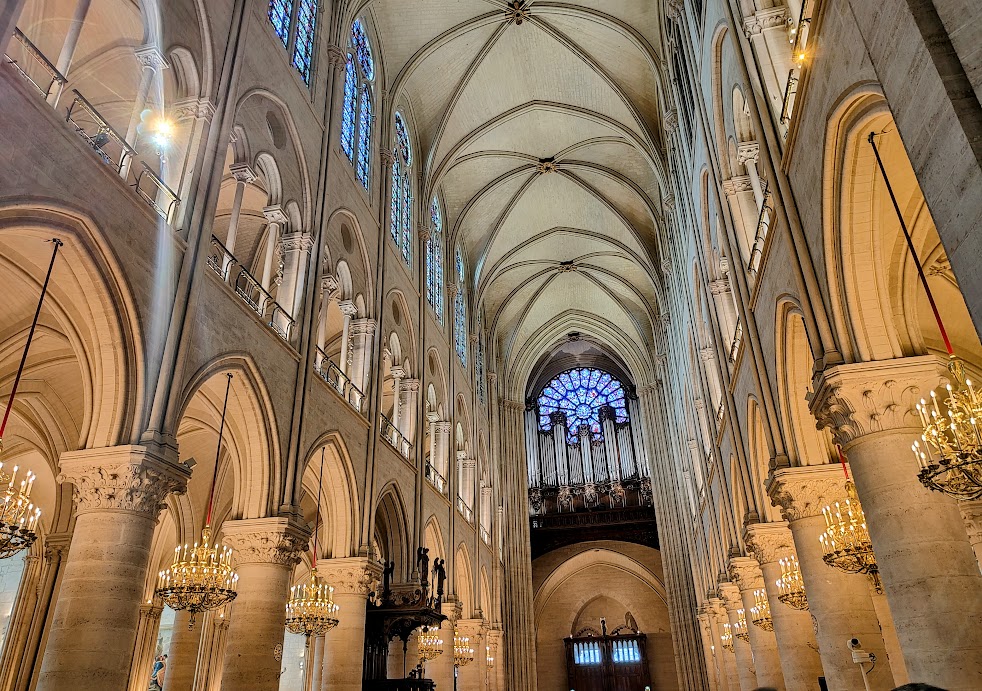
It was an impressive and deeply moving moment when France’s second largest organ (after that of Saint-Eustache, in Paris) let its 8,000 unique-sounding pipes resound. The pipes had just been completely cleaned. It was a prestigious Cavaillé-Coll organ that escaped the fire unscathed (the instrument was virtually untouched by water), but it was contaminated with yellow lead monoxide dust.
Strolling through a dream cathedral
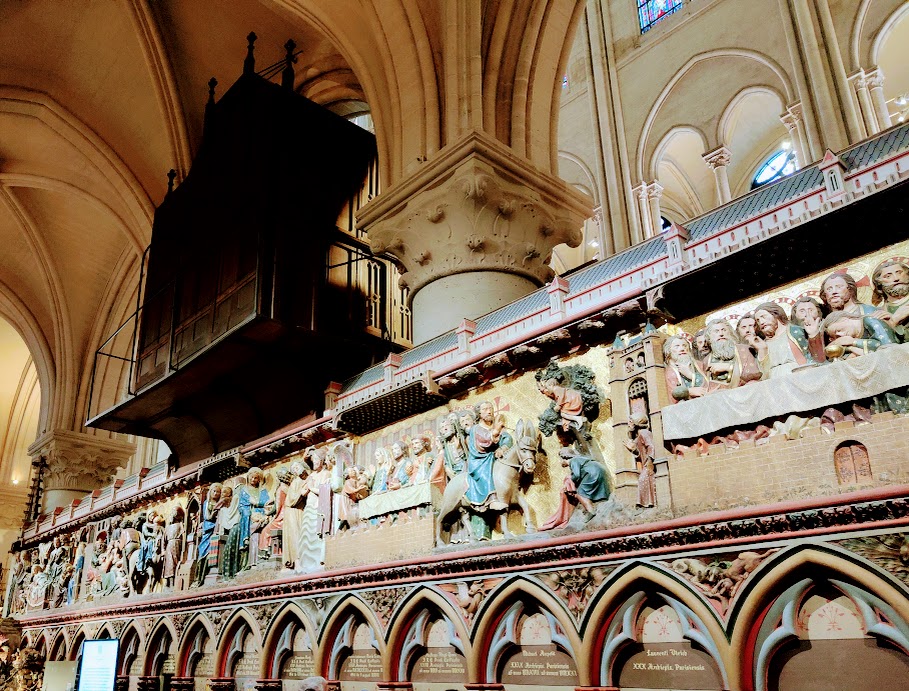
A new walk around the cathedral, which has been restored to the splendour left by its original builders! This walk goes from north to south, ‘from darkness to light’. The configuration of the route has been suggested on the basis of the cathedral’s unchanging features, in particular the chancel enclosure, which features a remarkable 14th-century sculpted wall separating the chancel from the ambulatory. This sculpted wall illustrates scenes from the life of Christ, with representations of his childhood and his public ministry to the north – in other words, the mystery of the Incarnation – and scenes from his Resurrection to the south.
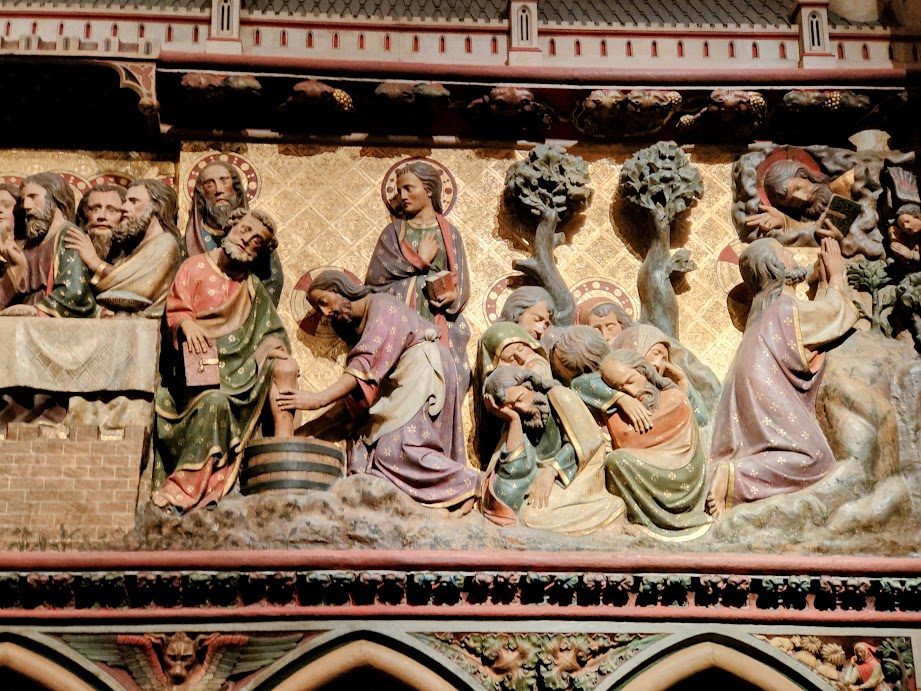
Among the 29 dazzling chapels, let’s stop for a moment…
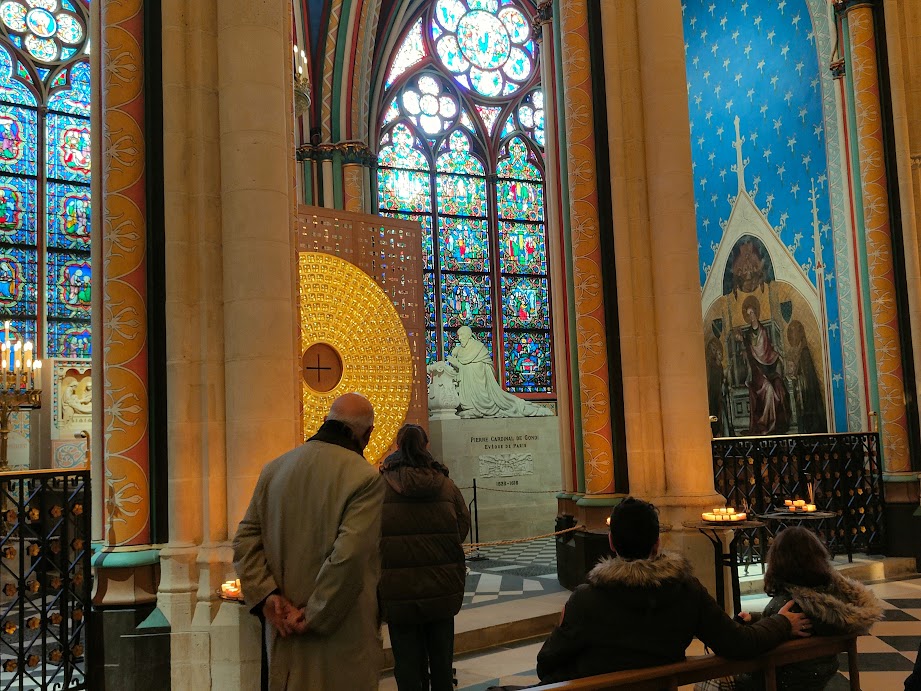
Take a stroll and discover some of the 29 chapels, including 14 side chapels around the nave and 5 ‘radiating’ chapels around the choir. The central chapel is dedicated to the Passion of Christ and contains the reliquary of the Crown of Thorns. These 29 chapels surrounding the nave and choir are bursting with colour and detail that had previously been tarnished by dirt and time. Restorers have revealed intricate wall paintings, gilded stars on the ceiling and vibrant patterns originally created under the direction of Eugène Viollet-le-Duc. They also made some unexpected discoveries, notably in the chapel of Our Lady of Guadalupe. Nestling in the ribs of the vaults, the teams found gilded fleurs-de-lis, created before Viollet-le-Duc’s restoration in 1843. It is estimated that these decorations were painted between the 12th and 15th centuries.
The Alley of Promises, to the north
Two alleys lead north and south to the choir enclosure. The north ambulatory is given over to chapels forming the ‘Alley of Promises’, a promise that directs Israel’s expectation towards the ‘Saviour’. Each chapel has a title corresponding to an Old Testament character associated with a theme. For example, there is the figure of King David (former chapel of Our Lady of Guadalupe), to whom the Psalms are attributed, and Abraham (former chapel of Saint Charles), father of the faith of the nations. There are also chapels dedicated to Noah, Moses, Isaiah, Solomon and Elijah.
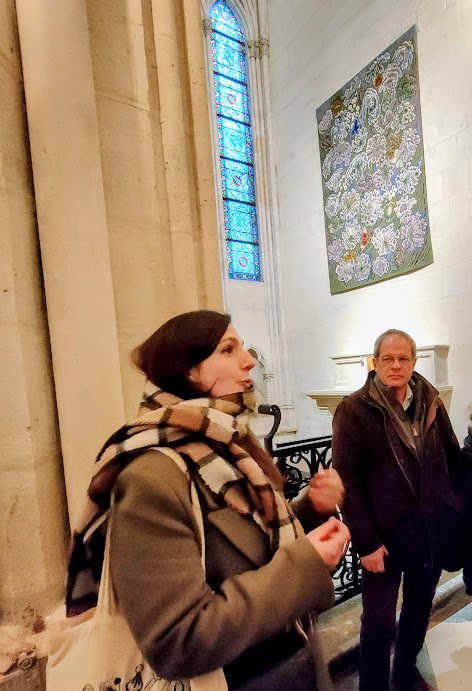


Pentecost Alley, to the south
To the south, at the end of the choir wall depicting the scenes after the Resurrection, the ambulatory is devoted to chapels forming the ‘Pentecost Alley’. Each chapel is dedicated to a saint of importance to the diocese of Paris: Saint Joseph, Saint Thomas Aquinas, Saint Clothilde, Saint Vincent de Paul, Saint Geneviève (patron saint of the city of Paris), Saint Denys and Saint Paul Chen. The chapels also feature the ‘Mays’, paintings commissioned by the Paris goldsmiths’ guild in homage to the Virgin Mary between 1630 and 1707. They depict biblical scenes and episodes from the lives of Saints.
The heart of Notre-Dame: its transept and choir
The transept crossing and its vaults have been restored using the same methods and materials as in the 13th century. As you will see, Notre-Dame de Paris is a hymn to the Virgin Mary. The famous statue of the Virgin carrying the infant Jesus is its emblematic figure. It is known as the ‘Virgin of the Pillar’ or, more simply, ‘Notre Dame de Paris’. It was sculpted in the early 14th century. For many, this was a sign: she miraculously remained intact amid the rubble after the fire on 15 November 2024. It is now back in its rightful place* at the foot of the south-west pillar of the transept crossing. It was here, next to this statue, that the poet Paul Claudel was converted during Christmas vespers in 1886. He had come to listen to the organ. Unable to join the faithful in the nave, he took refuge at the foot of this pillar.
* It was in 1855 that Viollet-le-Duc decided to install the organ in front of this pillar.
The design of the choir
Bishop Ulrich on the choice of liturgical material: ‘The material chosen, bronze, enters into a frank dialogue with the stone edifice. The baptistery appears as soon as you enter the cathedral, opening the door to the mystery of Christ; and the altar block, like a stone taken from the earth for the sacrifice, prepares itself as a fraternal table for the Lord’s Supper. But the purity of the lines, their simplicity, is also extremely accessible, even welcoming; a power of life, a calming strength emanates from this very simplicity.”


The extraordinary rose window in the north transept
Inside Notre-Dame, the rose windows burst forth from each end of the transept like flaming suns. The most beautiful, the oldest, is the one before us, in the north transept, unchanged since the 12th century*. Like the other two, they were miraculously spared the fire of 2019. They have not been restored, but cleaned. Would it give the impression of rotating with its 16 rays around the central oculus depicting the Virgin and Child. They are occupied by eighty figures from the Old Testament. But what is Notre-Dame de Paris if not a hymn to the glory of the Virgin?
*The rose in the north transept, attributed to Jean de Chelles, was begun around 1245 and largely reworked by Viollet-le-Duc Between 1862 And 1865.

A cathedral lit by 120 glass windows
Notre-Dame-de-Paris cathedral is lit by more than 120 stained glass windows dating from the 13th to the 20th century. During the fire, the vault served as protection, insulating more than 3,000 m² of glass surfaces. From 2026, contemporary stained glass will replace five of the six bays in the south aisle of Notre-Dame (on the Seine side), which were created in the 19th century by Viollet-Le-Duc. These windows, like the others, were not damaged by the fire but were very dirty. The Elysée, in agreement with the Archbishop of Paris, Mgr Laurent Ulrich, wishes to use this gesture to ‘mark the period of the fire and the restoration’. The announcement of the installation of contemporary stained-glass windows by Claire Tabouret, an artist with a resolutely modern style, continues to cause controversy.

Notre-Dame de Paris, the worksite of the century

The largest restoration project in Europe
It was (is!) the ‘worksite of the century’, the largest restoration project in Europe; a restoration that has been hailed the world over. To carry out such a project in such a short space of time (5 years) and with the prospect of a titanic restoration*, political will was needed. We owe it to a rather young president. He knew how to stay the course in the face of criticism and the pandemic that delayed the project. Above all, he needed a colossal budget. This was secured as soon as the last flames had extinguished the most famous cathedral in the world, a masterpiece of Gothic art over 860 years old.
*5 years of renovation, punctuated by incredible archaeological discoveries.
€140 million to complete the restoration
While worship and visits have resumed in a dazzling cathedral, €140 million is still needed for further work. Even before the fire in 2019, Notre-Dame was in a poor state of repair. A new restoration campaign will be undertaken on the exterior parts of the monument, including the cathedral’s apse. Another project: some of the large flying buttresses in the chevet have become fragile over time. They require urgent work. As you can see, although Notre-Dame has been reborn even more impressive from the ordeal of fire, it is a fragile edifice whose upkeep is the responsibility of our generation and those to come.
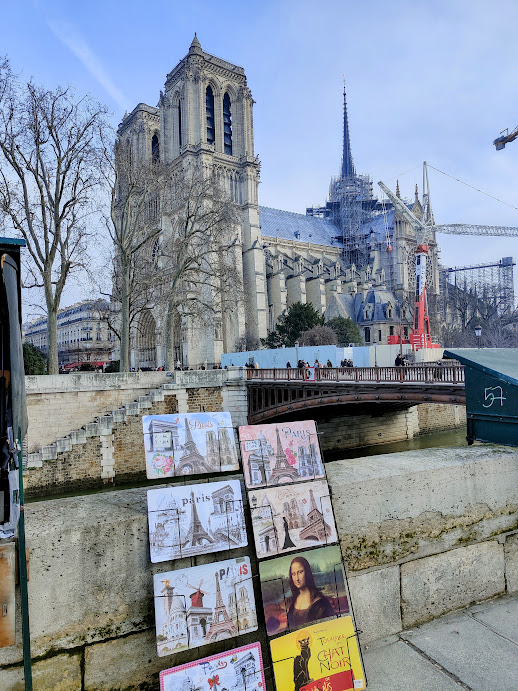
Translation under the supervision of Lynn Jennings-Collombet (www.lajuberdiere.com)
 amazed